
Roster Overview and Planning
The Roster provides a view of scheduled Activities and Staff Shifts, with filters, colour options and date ranges to help you focus on what you need to see.
Support Staff use the Roster to view the Shifts they are rostered into. Team Leaders, rostering teams and managers use it to plan the Roster, fill and replace Shifts, create Activities, and respond to changes on the day. Filters, icons and coloured stripes help identify the Activities and Shifts that need attention.
Audience: Authorised Customer Representatives, Team Leaders, Rostering Teams, Support Staff
Summary
The following list summarises the content within this article. Click on the links below to take you to the relevant sections:
- What you can see
- Views
- What each View can display
- Filtering the Roster
- Choosing your date range
- How the Roster is displayed
- Reading the Roster cards
- Agenda view
- Timeline view
- Creating Activities from the Roster
- Keeping the Roster up to date
- Printing the Roster
- The Old Roster
- Version history
What you can see
What you see in the Roster depends on the privileges configured in your Staff Account.
Support Staff see the Shifts they are rostered into in the Calendar view. The Staff Member filter and the Status filter are not displayed, as only your own Roster is available to you.
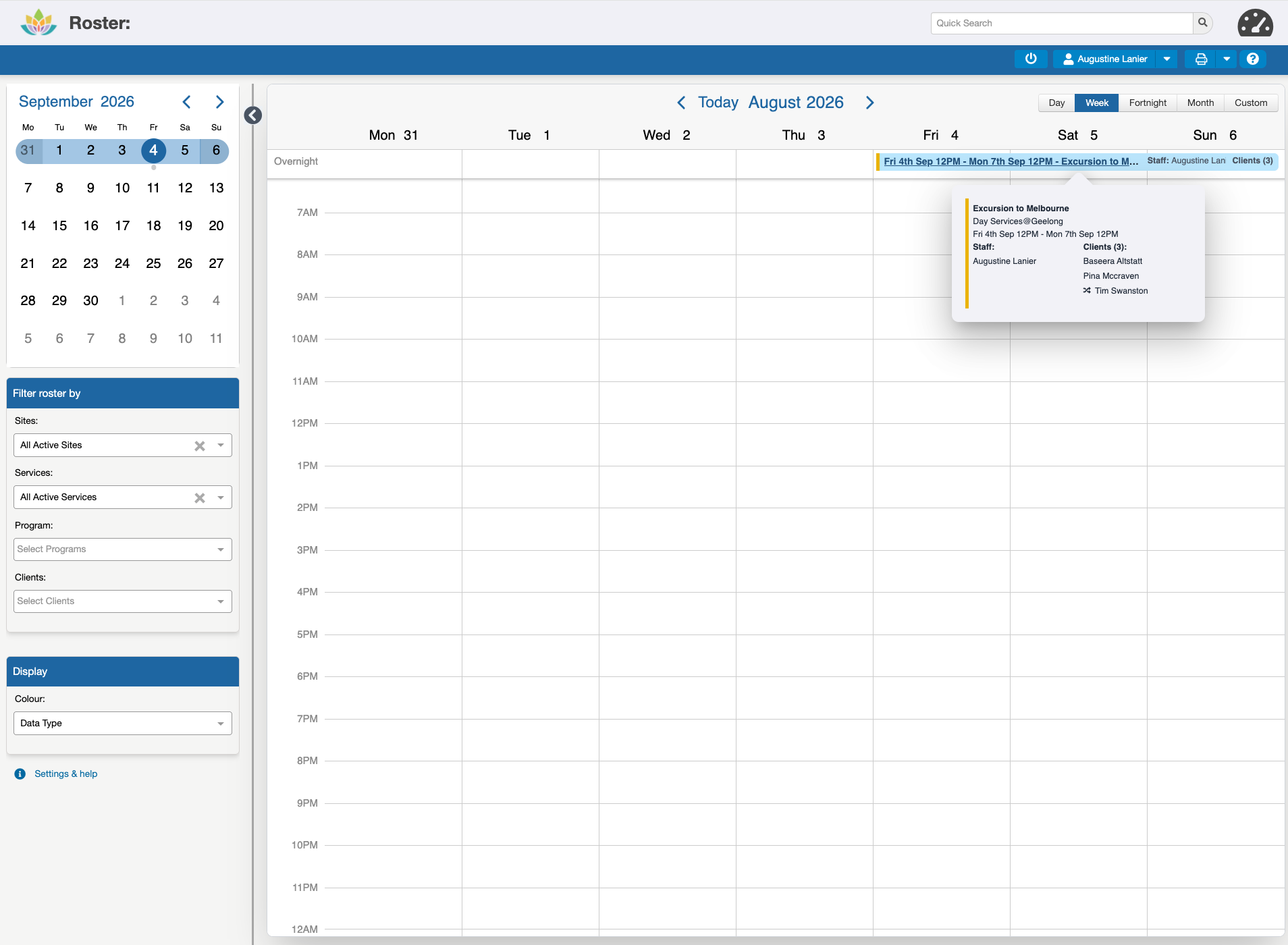
Staff with the privilege to manage Activities, such as Team Leaders and rostering teams, see the Roster for the Sites and Services they have access to. All three Views are available, along with additional filters and the ability to create Activities and fill Shifts.
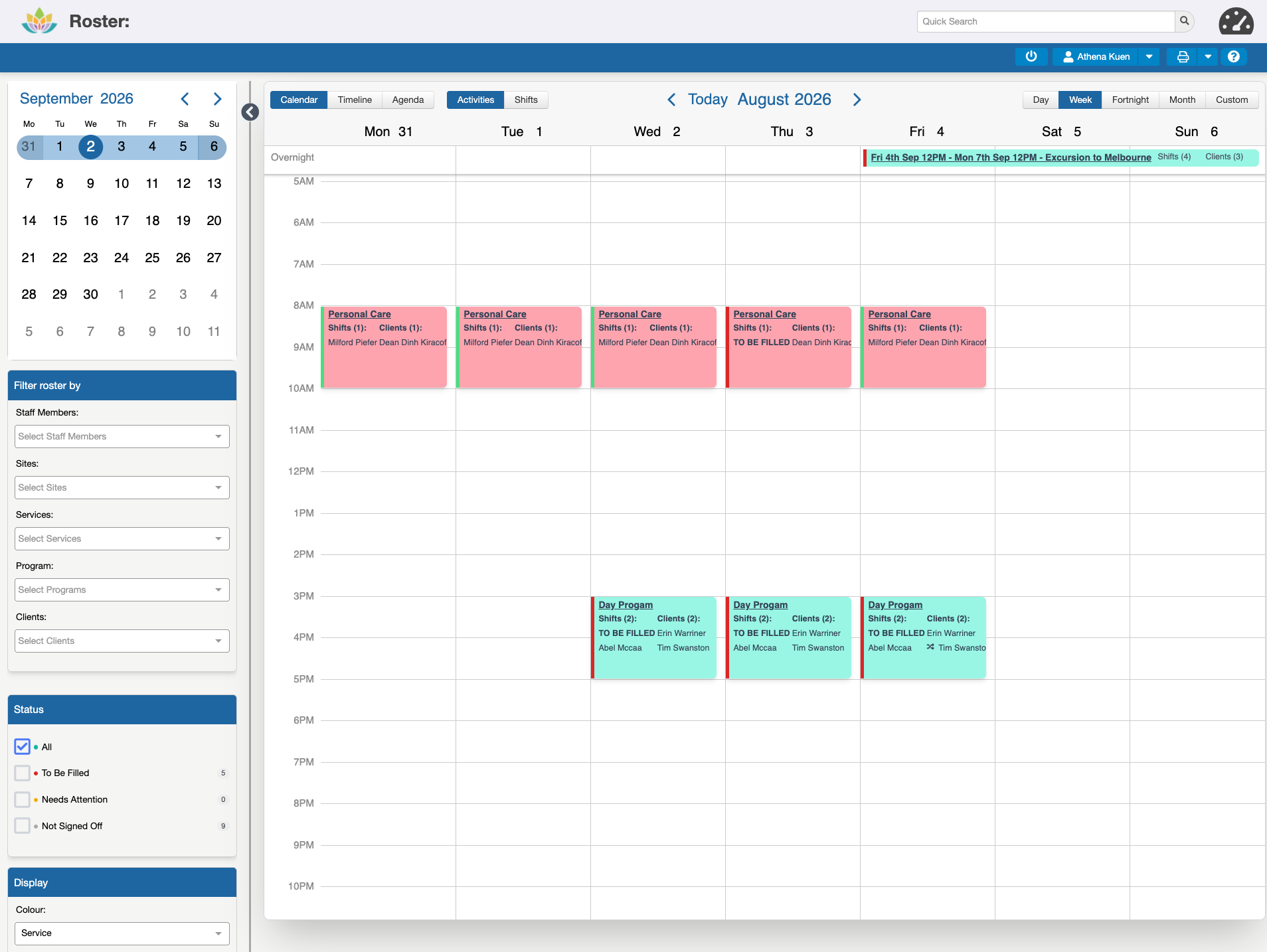
When you first open the Roster as a Team Leader, your own name is selected in the Staff Member filter by default. Once you update your filters, SupportAbility remembers your selections and applies them the next time you open the Roster.
Views
Three Views of the Roster are available, selected from the toggle at the top left of the screen:

- Calendar, available to all staff, displays Activities or Shifts laid out against the calendar
- Agenda, available to staff with the privilege to manage Activities, lists Activities or Shifts in rows
- Timeline, available to staff with the privilege to manage Activities, displays Shifts for a single day against a row for each Staff Member
Alongside the view toggle, an Activities and Shifts toggle controls what the Roster displays. The date navigation sits in the centre of the bar, and the period options sit to the right.
Where only one option is available in the current View, that option is displayed as a plain label rather than an interactive control, so you always have context without being offered a choice that does not exist. In the Timeline view, for example, 'Shifts' and 'Day' are displayed as labels.
What each View can display
Not every combination of data and date range is available in every View.
Calendar
- Activities or Shifts, using the relevant toggle. Support Staff see their own Shifts, and the toggle is not displayed.
- Day, Week, Fortnight, Month and Custom (up to 1 month)
Agenda, displaying Activities
- Day, Week, Fortnight, Month and Custom (up to 1 month)
Agenda, displaying Shifts
- Day, Week, Fortnight, Month and Custom (up to 1 month), displaying up to 1,700 results at once. Please see Agenda view below.
Timeline
- Shifts only, displayed as a label
- Day only, displayed as a label
Filtering the Roster
The 'Filter roster by' section in the left-hand sidebar controls which Activities and Shifts are displayed in the Roster.
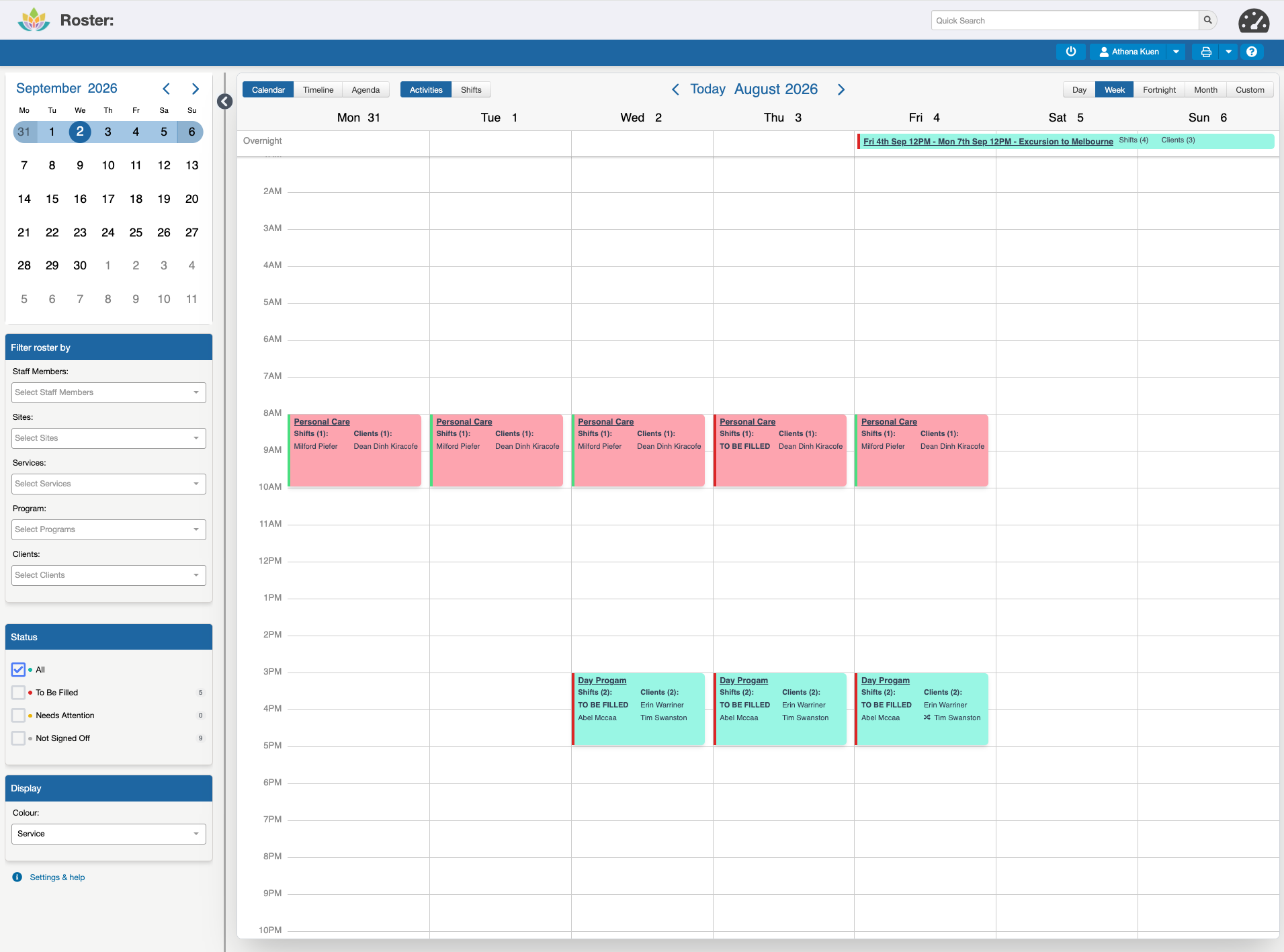
Calendar
The calendar at the top of the sidebar lets you navigate to different dates, and the blue arrows move between relevant time periods.
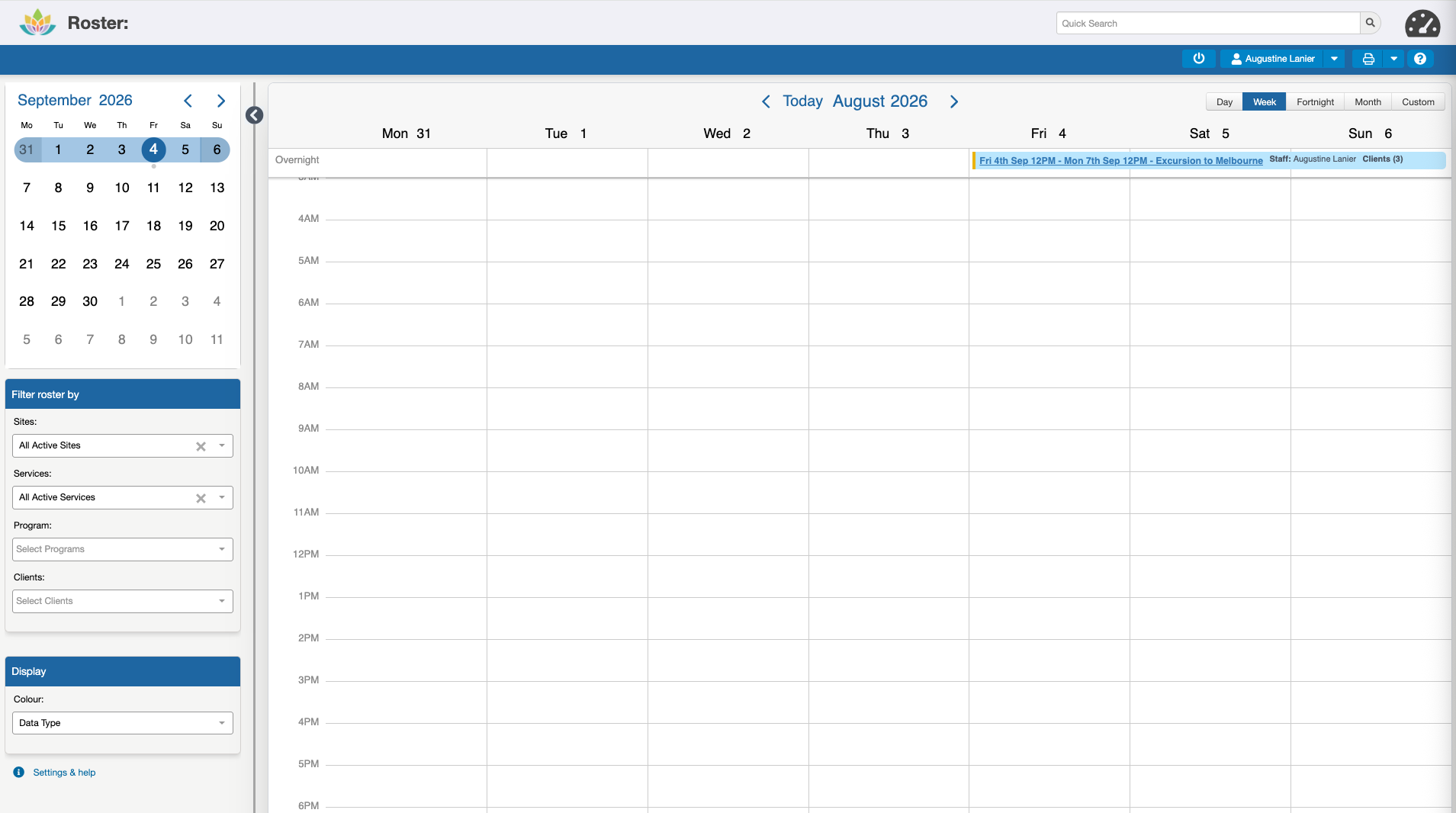
When viewing your own Roster, a grey dot appears beneath any date with a rostered Shift.
The arrows on either side of 'Today', in the centre of the top bar, also navigate forward and back based on the date range selected. Selecting 'Today' returns you to the current date.
Staff Member, Site, Service, Program and Client filters
Below the calendar are filters for Staff Member, Site, Service, Program and Client. The Staff Member filter is not displayed to staff who do not have the privilege to manage Activities.
When viewing your own Roster, these filters can be used to display the Shifts you are rostered into for particular Sites, Services or Programs, or for particular Clients scheduled into those Activities.
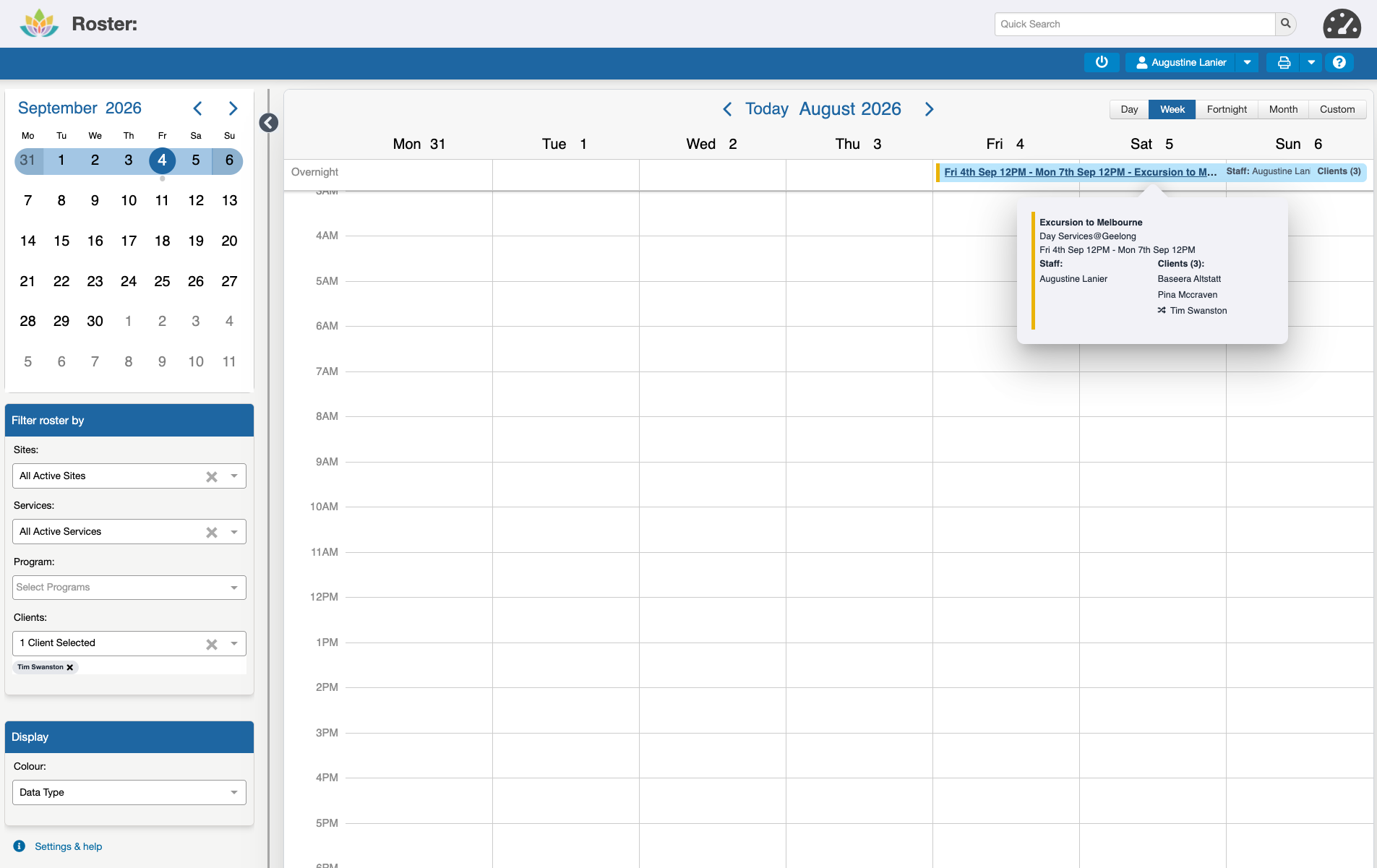
Rostering staff, Team Leaders and managers can view the Roster holistically, or refine what is displayed using the relevant filters.
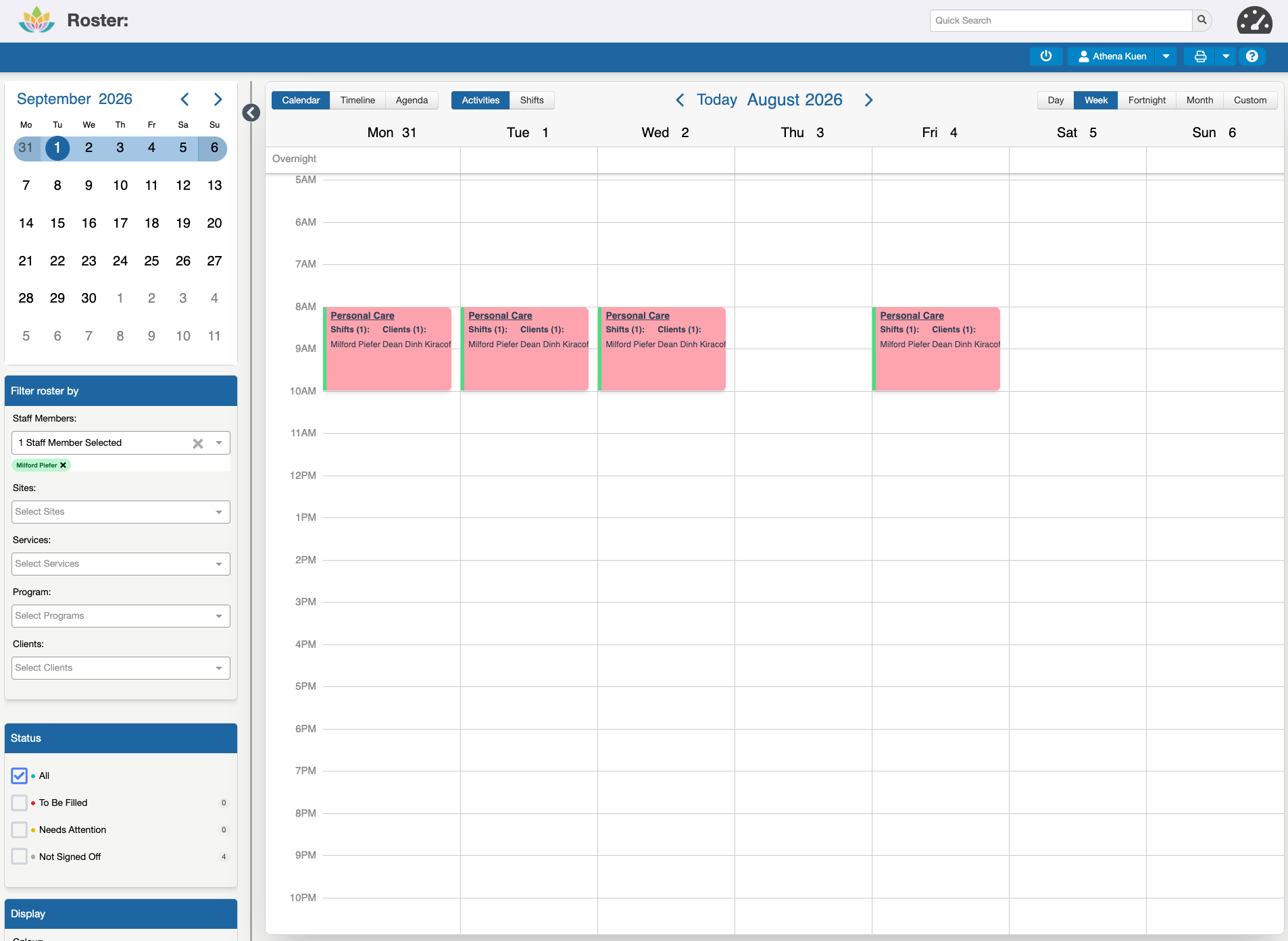
Inactive Staff Members are only listed in the Staff Member filter, including when searching by name, where they have Shifts within the displayed date range. This keeps the list clear when rostering ahead, while still allowing you to find them when reviewing a period they worked. The list updates when you change the date range, and a Staff Member you have already selected remains selected.
The same applies to the search bar in the Timeline view.
Filter chips
Your selections appear as removable chips directly beneath each filter, so it is clear how the Roster is filtered without reopening a menu.
Where a long list is selected, the first five are displayed with a '+N' button that opens the full list. Chips can be removed individually, or select 'Clear all' to remove them in one action.
Status
The Status filter narrows the Roster to the Activities and Shifts that need attention. It is available to staff with the privilege to manage Activities.
- All, no Status filtering applied
- To Be Filled, Shifts that do not yet have a Staff Member allocated
- Needs Attention, Staff Clashes, Client Conflicts and Client Absences
- Not Signed Off, which reflects the Sign Off state of the Activity or the Shift, depending on which you are viewing
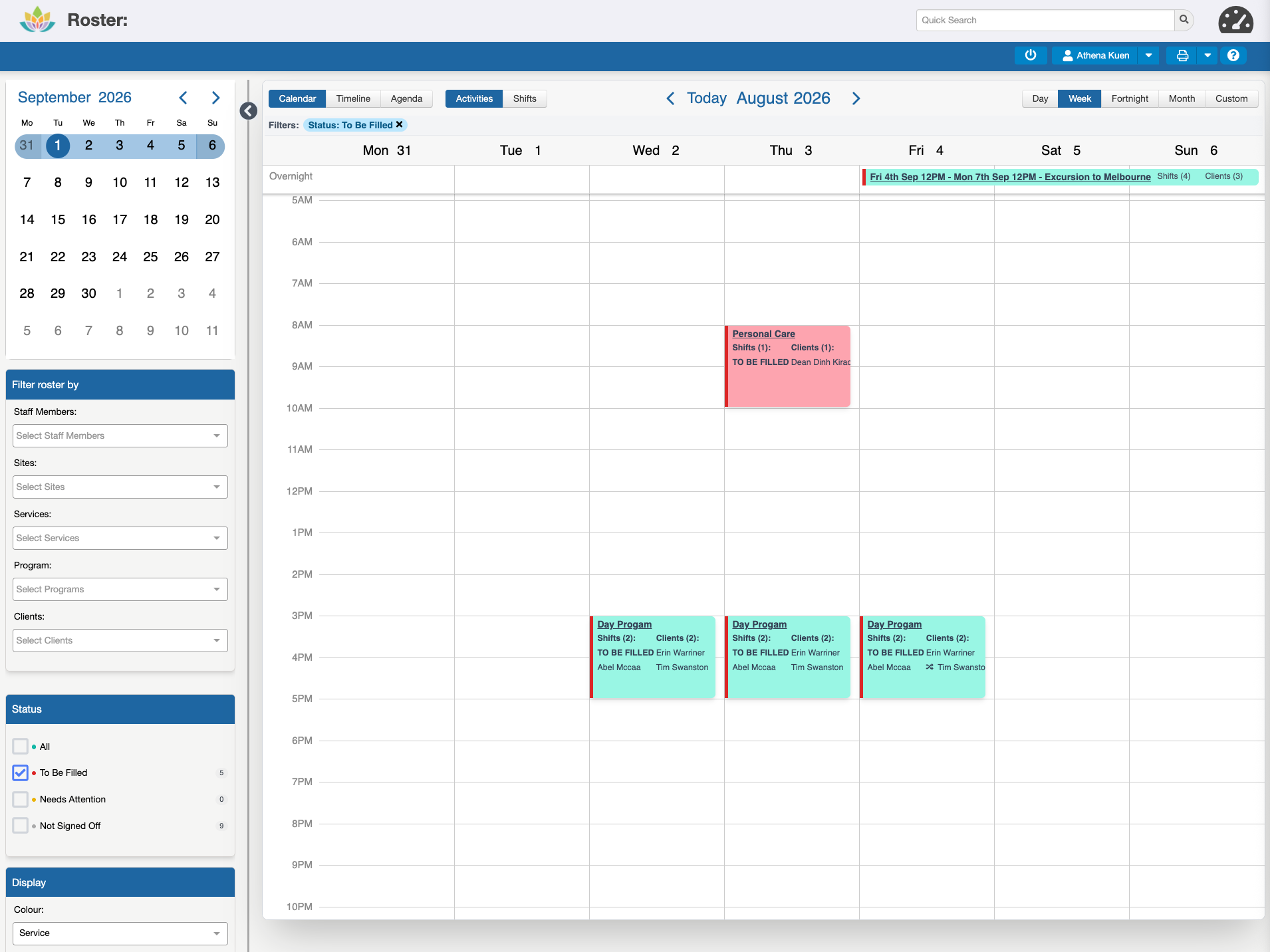
Status works alongside your other filters, and the Roster updates instantly, with no reload required. It applies in the Calendar, Agenda and Timeline views.
Your active Status also appears as a removable chip above the Roster, so it remains visible even when the sidebar is collapsed.
Choosing your date range
Fortnight aligns with your organisation's configured Pay Period. If your pay cycle starts on a Wednesday, the Fortnight range starts on a Wednesday and the day columns read from that day.
Please see the Configuring the Pay Period for your organisation article for more information.

Custom allows selecting a date range of up to one month. This is designed to let you focus on a specific date range, for example, an excursion or a camp that spans several days.
The calendar in the sidebar displays your selection as a highlighted band with clear start and end points.
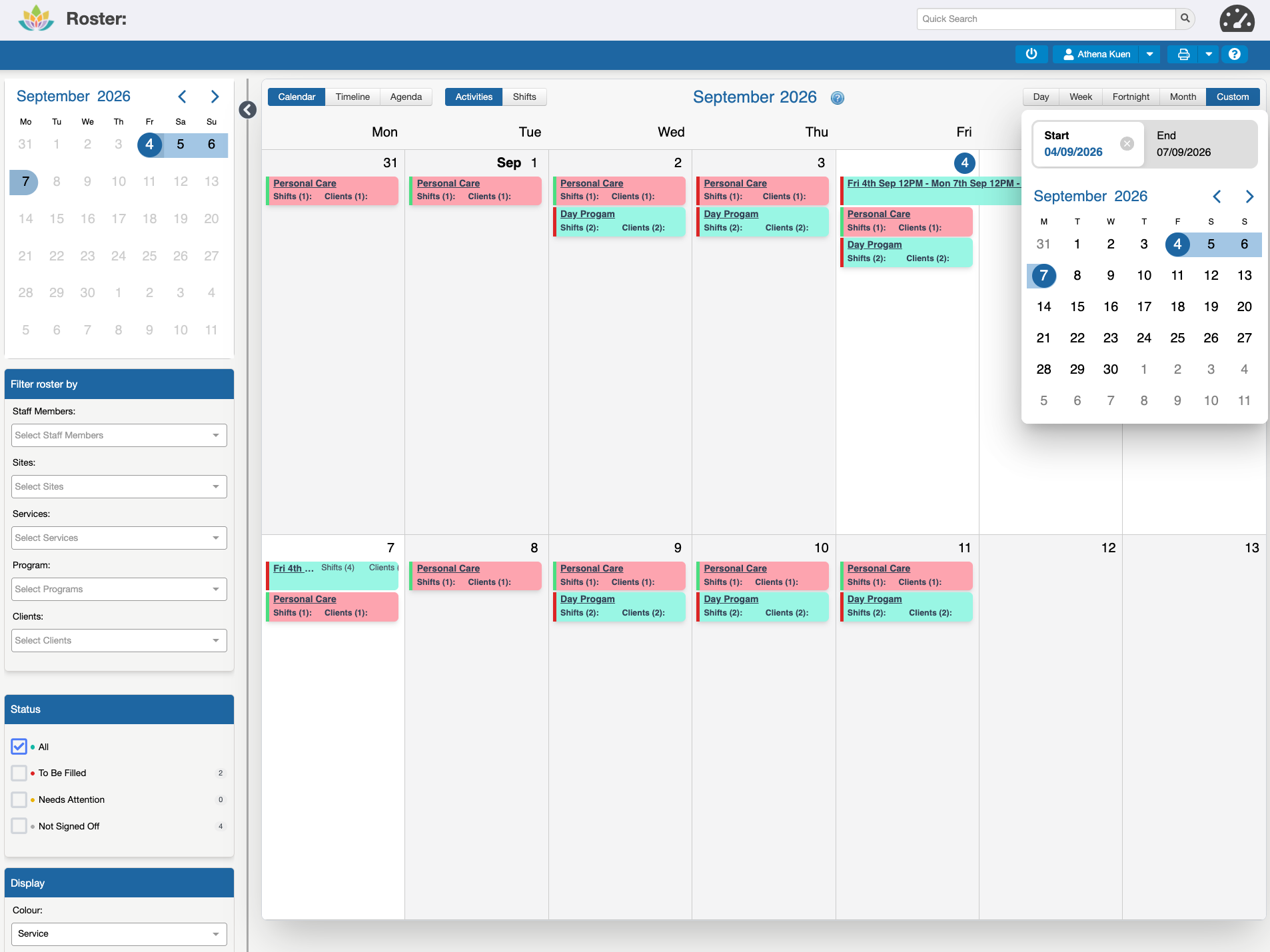
When a Custom range is selected, the forward and back navigation arrows are unavailable because the range is defined by the dates you have chosen. Select a different date range, or a new Custom range, to move to other dates.
How the Roster is displayed
The 'Display' section at the bottom of the sidebar controls how the Roster looks, as distinct from the data it displays.
Roster cards can be coloured by Data Type, Site or Service. This is controlled in the 'Display' section on the bottom left of the screen:

Data Type is the default. Activities are displayed with a white background, except in the Calendar view, where they are green. Shifts are displayed with a white background, except in the Calendar view, where they are blue.
Site and Service colour every Activity and Shift relating to the same Site or Service with the same background, making it easier to identify at a glance where each Shift or Activity is scheduled.
SupportAbility assigns these colours automatically from a palette of 28 accessible colour sets, ensuring clear contrast, readability and consistency for all users. The same colour always appears for the same Site or Service, keeping your Roster visually stable. In addition:
- Colours are assigned in alphabetical order by active Site or Service name.
- Deactivated Sites or Services appear last in the list, so active ones keep their colours.
- Everyone sees the same colour for the same Site or Service.
- Once all 28 colours are used, the palette repeats from the beginning.
- Adding, deactivating or reactivating Sites or Services does not change existing colours.
When switching between Site and Service, you may notice some colours appear the same. This is expected. Both use the same palette, but colours are applied independently within each list.
The Colour selection changes card colour only. It does not change the order or grouping of the Agenda view.
Reading the Roster cards
Coloured stripes and icons on each card help you interpret the Roster at a glance. These are displayed regardless of the Colour option selected.
Coloured stripes
A coloured stripe on the left border of an Activity or Shift indicates the following:
- Green (Activities), Activity not Signed Off
- Navy blue (Shifts), Activity not Signed Off
- Grey, Activity has been Signed Off
- Amber, something needs attention, for example an Availability issue
- Red, something needs attention, for example a To Be Filled Shift
Icons
- Aeroplane (Activity and Shift), Staff Clash or Availability issue
- Person X (Activity and Shift), Client marked as Absent
- Tick (Shift), Staff Shift Signed Off
- Hammer (Activity), Activity has been Signed Off
Hover for more information
Hovering over any card displays more information, such as the Site and Service of the Activity, the rostered Staff and the participating Clients.
To open the Activity a Shift belongs to, select the Activity name link on the card. The Activity opens in a new tab and the Roster remains open in the previous tab.
When Week or Day is selected, more information is displayed on each card, and a blue line indicates the current time across the week or day.
In the Week and Day layouts, the length of the Shift determines how much information fits on the card. Hovering over a short Shift, for example ten minutes, displays the full details.
Agenda view
The Agenda view lists Activities and Shifts in rows rather than against a calendar. This is similar to the List view in the Old Roster and is useful when reviewing a large number of Activities, such as across multiple Sites or Services.
Both Activities and Shifts can be viewed in this format, using the Activities and Shifts toggle:

To open an Activity, select the Activity name.
Activities can be created from the Agenda view using the 'Add Activity' button. Please see Creating Activities from the Roster below.
Display Limits
When displaying Shifts, the Agenda view can display up to 1,700 results at once. Where the date range and filters selected include more than this, the following message is displayed in place of the Shifts:
This view has (n) results, more than the Agenda view limit (1,700). Please narrow your date range or filters to see them.
Filtering by Staff Member, Site, Service, Program or Client, or selecting a shorter date range, will display the Shifts. For example, a Month view filtered to a single Staff Member is useful for arranging cover when someone is unwell, reviewing a Staff Member's days off, or checking a casual Staff Member's hours across a Pay Period.
Sort Order
Activities and Shifts are listed in start time order. Where several start at the same time, they are grouped by Service @ Site, with the label displayed once against the first row of each group. Groups, and the rows within each group, are ordered by end time. The same Service @ Site can appear more than once in a day, as a separate group for each start time.
Activities and Shifts already underway from the previous day are displayed at the top, showing their start date.
View Staff Notes
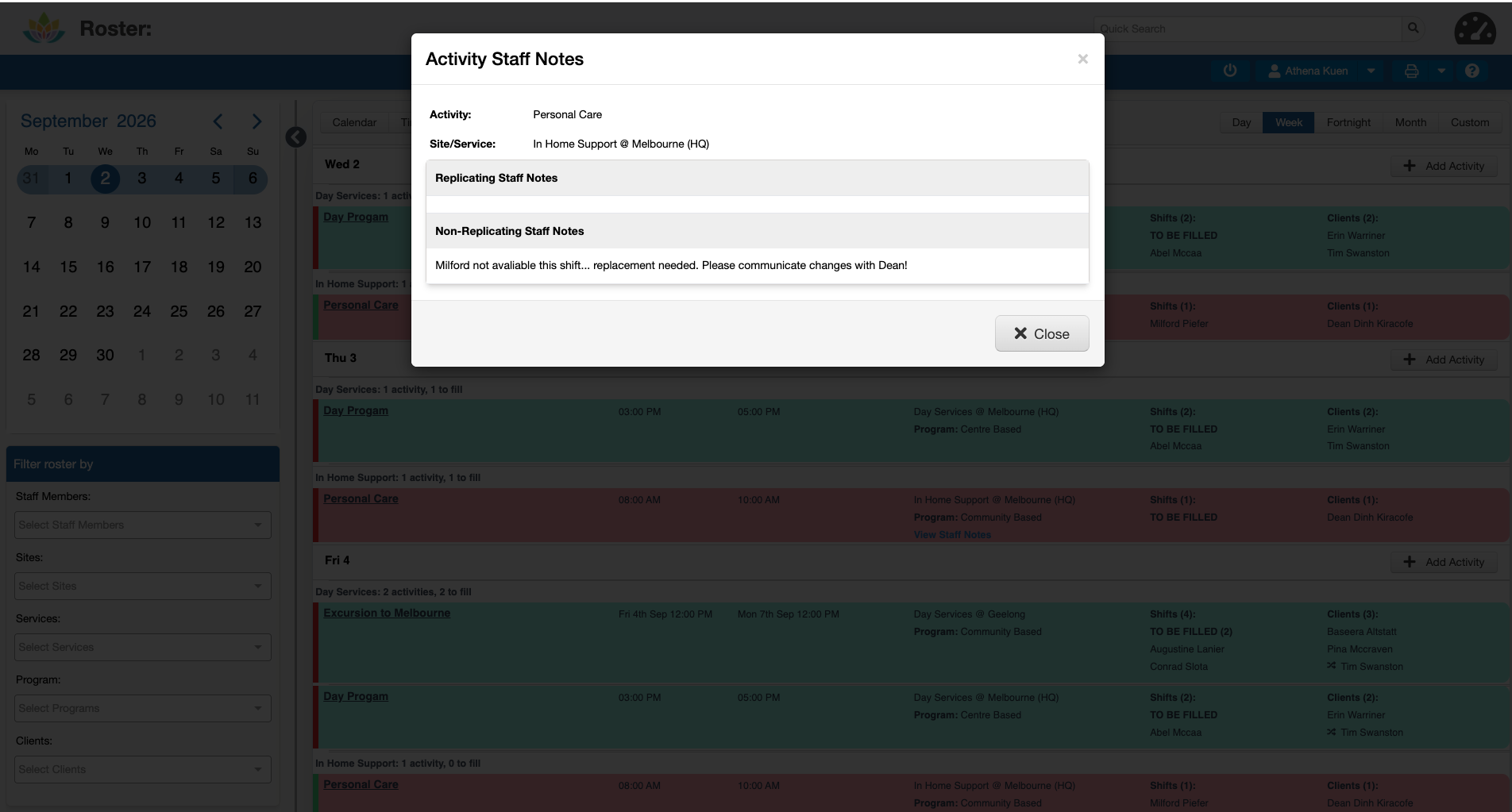
In addition to the regular Activity details, the Agenda view displays the Activity Location, and 'View Staff Notes' displays any Replicating or Non-Replicating Staff Notes added to the Activity.
Timeline view
The Timeline view displays Shifts for a single day, with a row for each Staff Member. It is designed to assist rostering teams and Team Leaders in filling 'To Be Filled' Shifts and updating Shifts on the day, for example when someone calls in sick.
Roster cards in the Timeline view are sorted by modified date, so the most recently updated records appear first.
Searching for staff
A search bar sits directly above the staff rows, allowing you to filter the staff list by Staff Member name, Site, Service, Program and Employment Type all at once.
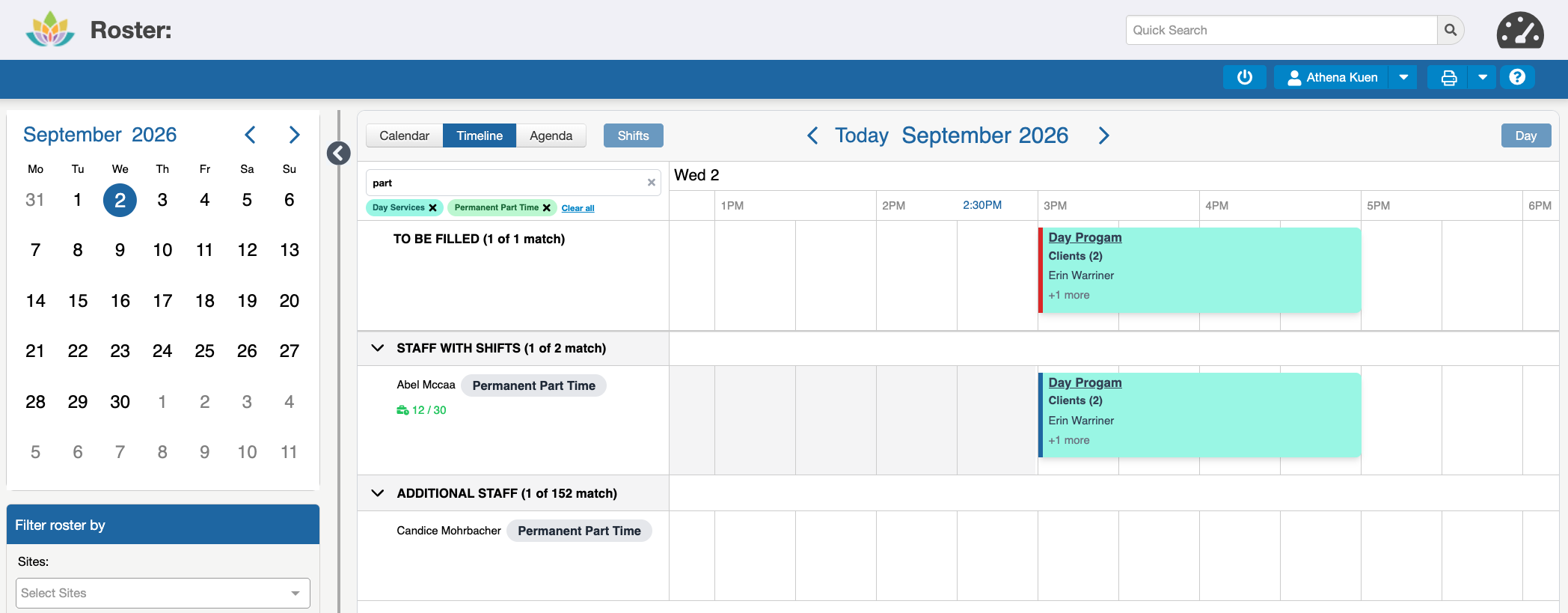
Your selections are displayed as removable tags in the search bar, with a '+N' button where there are more than can be displayed.
Filters can be stacked to refine the list of suitable Staff Members, for example, 'Day Services' and 'Perm Part Time', so you can quickly identify who is appropriate to fill or take a Shift.
Staff and Shifts that do not match are not displayed, and each group header shows a match count, for example '1 of 2 match', so you always know when there is data sitting outside your filters.
This includes the 'To Be Filled' group, so if a filter is hiding an unfilled Shift, this is displayed as '0 of 1 match' rather than as an empty section.
Where a Shift exists for a Staff Member in the 'Staff Without Visible Shifts' section but is not visible due to your filters, the time they are busy is displayed as unavailable with diagonal grey lines. For example, a Staff Member scheduled into a SIL Shift will display this way when the SIL house is not one of the Sites selected.
Agreed Hours
Each Staff Member's Agreed Hours are displayed in their row, providing a real-time snapshot of their total rostered hours within their agreed period, either Week or Fortnight, based on your organisation's configured Pay Period. This makes it easier to identify available capacity and assess potential overtime risk while building or adjusting the Roster.
Agreed Hours are displayed in the format Rostered / Agreed, for example 12 / 30h, alongside a 'business time' icon.
The icon is colour-coded so the status can be assessed at a glance:
- Green, the Staff Member is within their Agreed Hours for the period
- Red, the Staff Member is at or over their Agreed Hours for the period, indicating potential overtime risk
Hovering over the icon displays the text 'Agreed Hours'.
The calculation is based on the day you have navigated to. If you navigate to a date outside the current Pay Period, the figure reflects the rostered hours for that period. Hours from Shifts marked as 'Not Paid' are excluded.
Reassigning a Shift via drag and drop updates the rostered hours for both the originating and the receiving Staff Member in real time.
Please note: Agreed Hours are only displayed once your organisation's Pay Period has been configured. The icon is not displayed next to Staff Members who do not have Agreed Hours configured. Please see the Configuring the Pay Period for your organisation article for more information.
Staff Availability
When a Staff Member is not available, they are displayed in grey, or grey with a diagonal stripe.
Grey means they are not available at this time, due to either their Standard Availability or an Unavailable Leave Exception.
Grey with a diagonal stripe means they are rostered into a Shift for a different Site or Service at that time.
Both means both situations apply.
Drag and drop to allocate or change a Shift
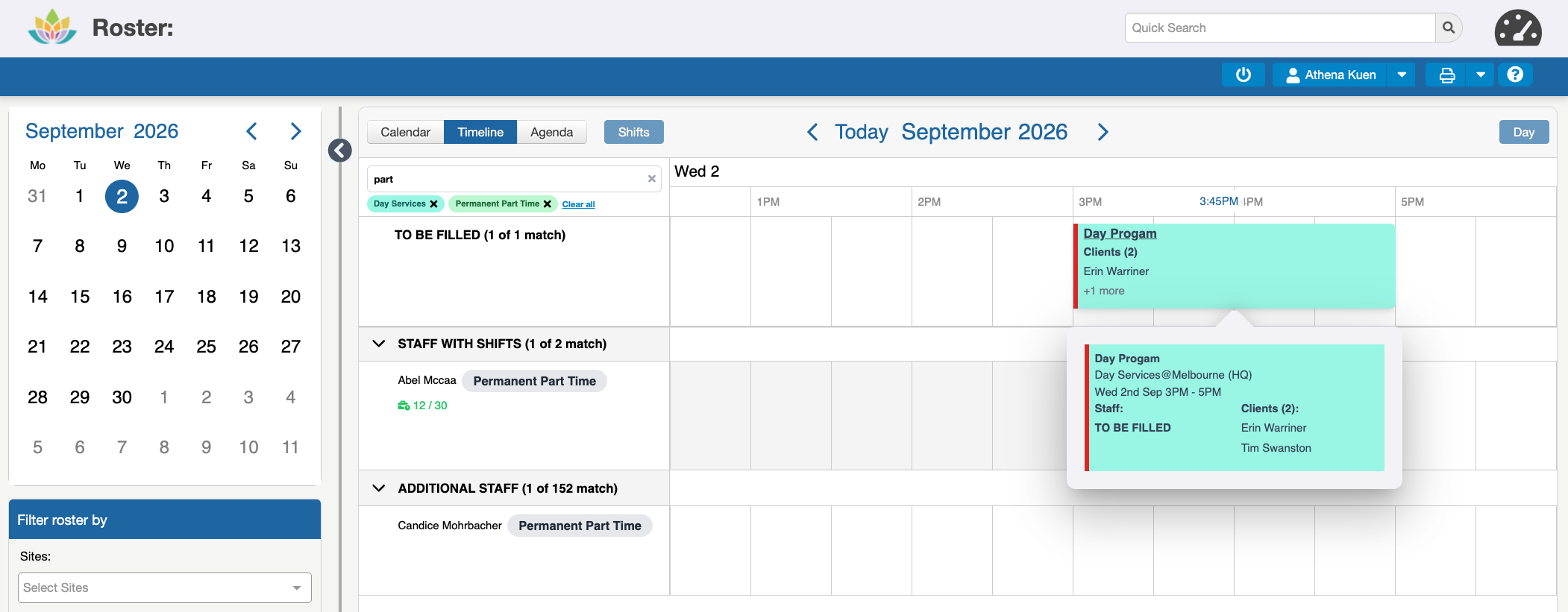
To Be Filled Shifts can be filled, and rostered Shifts can be moved from one Staff Member to another, by dragging and dropping the Shift onto the relevant Staff Member.
After allocating a Shift, you are returned to that Staff Member's row in the 'Staff With Shifts' section, with a brief highlight on the newly allocated Shift, so you can continue working through the Roster without losing your place.
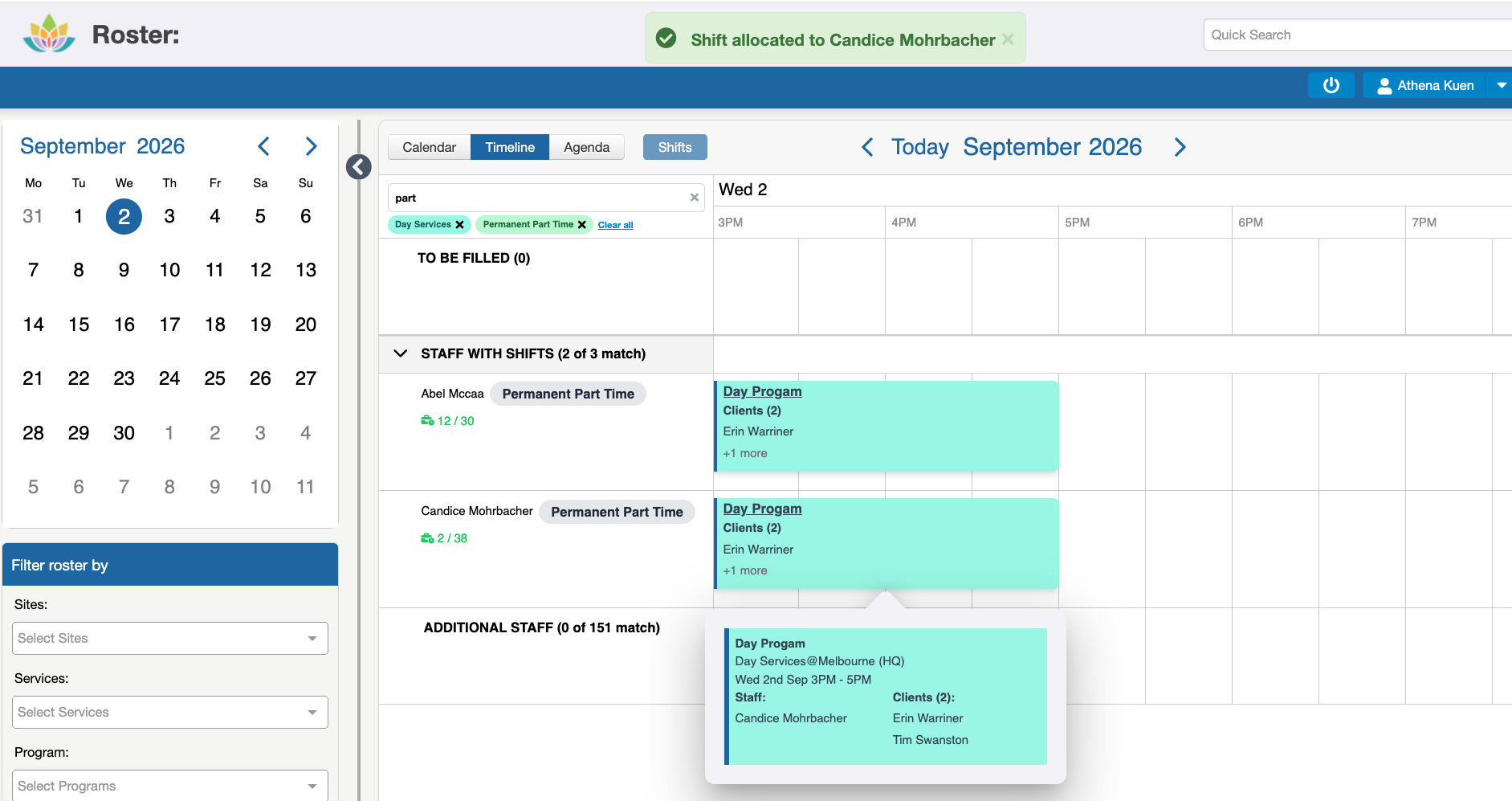
There is no confirmation step for a standard allocation, as confirming every intentional change would slow rostering teams down. Confirmation is only required where allocating the Shift will result in:
- recorded Shift data being lost
- the Staff Shift Sign Off being removed
- a Staff Clash, or
- an Availability issue
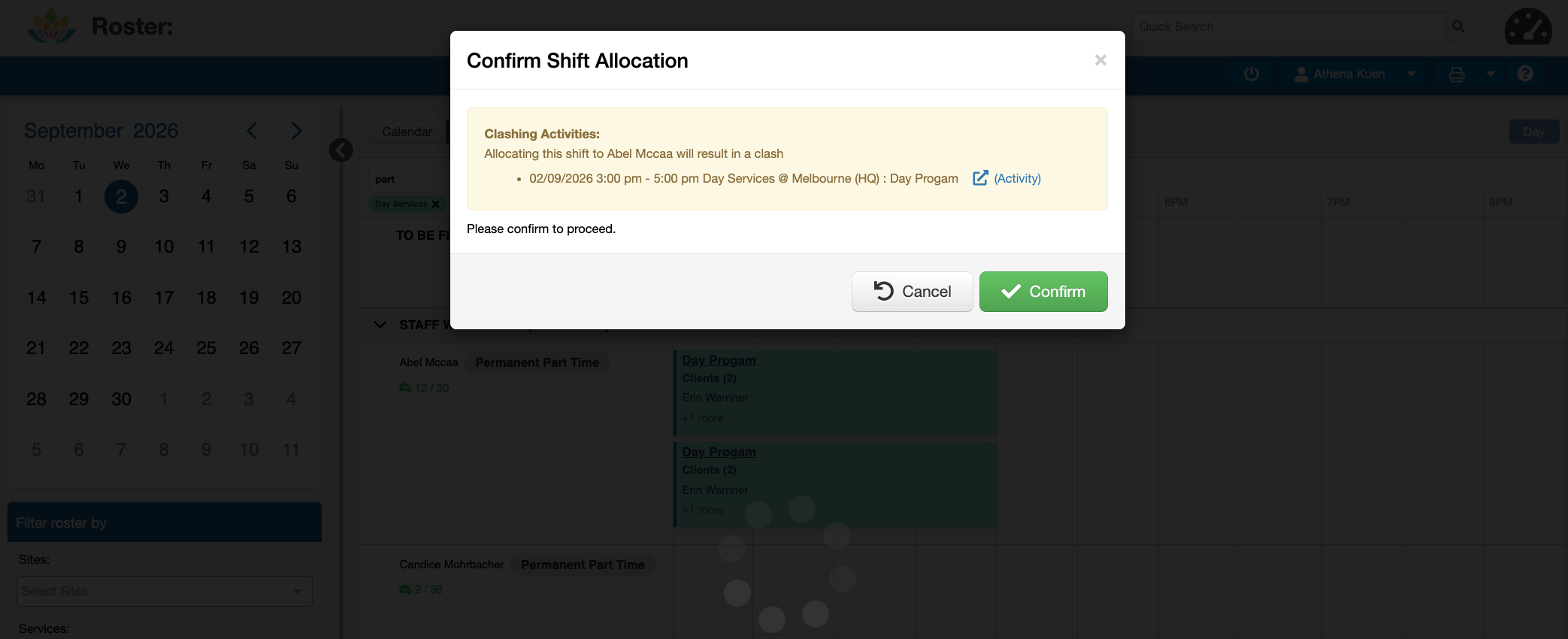
Please note: when allocating Shifts in the Roster, the Activity Replication Management settings are not triggered, even where they are enabled. No staffing changes are made to the remaining Activities in the Set when Shifts are filled or changed.
Finding a suitable Staff Member
Use the search bar above the staff rows to narrow the list before you drag and drop, for example by Service and Employment Type, so that only suitable Staff Members are displayed.
For example, to move a Shift from a Staff Member who is double booked to someone else, filter the list to the relevant Service and Employment Type, then drag the Shift to the Staff Member you want to allocate it to.
Creating Activities from the Roster
Staff with Team Leader privileges can create Activities directly from the Roster, from either the Calendar view or the Agenda view.
When adding an Activity from the Calendar view, your filters pre-populate key details such as Site, Service, Staff Member and Client, provided a single item is selected in each filter.
Single-click the relevant date and time to create a one-hour activity from the start of that hour. Clicking 10:30am, for example:
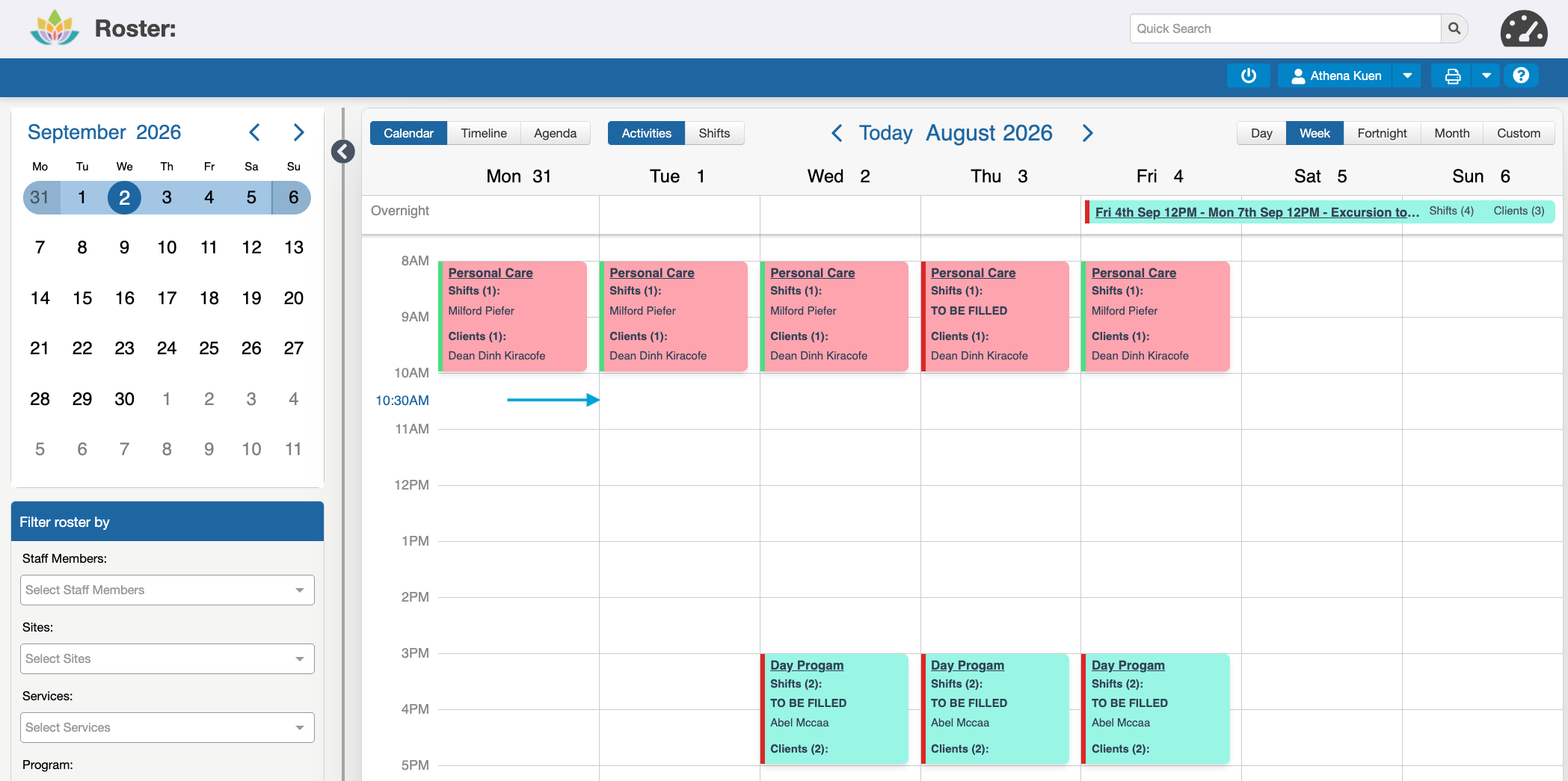
Alternatively, click and drag to select the required duration, for example 10:30am to 11:30am.
The 'Add a New Activity' set-up wizard then opens. After the Activity Details, add the relevant Clients.
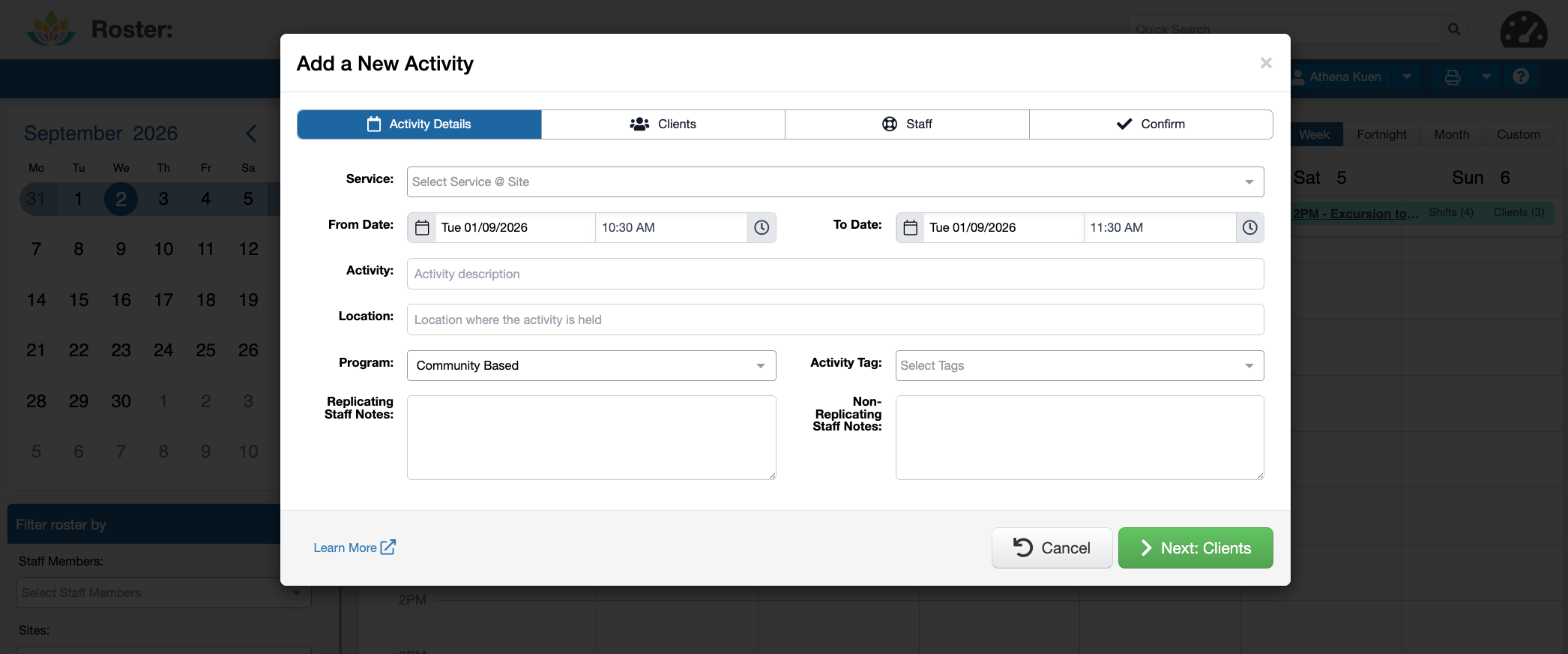
Then add the relevant Staff, or the number of 'To Be Filled' Shifts required. If you do not yet know who will be rostered into the Activity, or where several Staff Shifts are required, add the number of To Be Filled Shifts here.
If the Shift times differ from the Activity time, they can be edited in the Activity record once it has been created. If you know the Staff Member you want to add, they can be selected here, or you can search by name or Employment Type.
Where the Pay Period has been configured, each Staff Member's total Agreed Hours and Potential Overtime risk for their agreed period, inclusive of the Activity duration, is displayed. This is most useful where the Staff Shift times align with the Activity time. Where an Activity has several Shifts with times that differ from the Activity time, such as camps or SIL, this information is more useful at the Shift level within the Activity record. Please see the How to fill 'To Be Filled' Shifts and change a Staff Member in a Shift article for more information.
Select 'Next: Confirm', review the summary, then select 'Add Activity'. You can then navigate to the new Activity, create another, or close the wizard and return to the Roster.
Keeping the Roster up to date
When a change to the underlying data is detected, a refresh indicator appears. Selecting this loads the updated data far more efficiently than a browser refresh, and keeps you on the selected date.
Printing the Roster
Select the print icon at the top of the Roster to print the current View.
Agenda view
The Print Options dialogue lists additional data to include in the roster print:
- Activity Location
- Replicating Staff Notes
- Non-Replicating Staff Notes
All three are selected by default. The print includes the date, individual Shift start and finish times, Staff and Clients, along with the options selected. Staff Notes print in full. These options apply to the print only, and do not change what is displayed on screen.

Activities and Shifts are not split across pages.
Calendar view
The Calendar view prints straight away, with no options.
Timeline view
Printing is not currently available in the Timeline view. Selecting the print icon displays a message asking you to select the Calendar or Agenda view.
Please note: where you keep a daily printed or PDF copy of the Roster as a backup, for example for business continuity, we recommend printing from the Agenda view with Shifts displayed, as this provides the most complete record.
The Old Roster
The previous version of the Roster remains available. Select the settings menu at the bottom left of the Roster and choose 'Go back to Old Roster'.
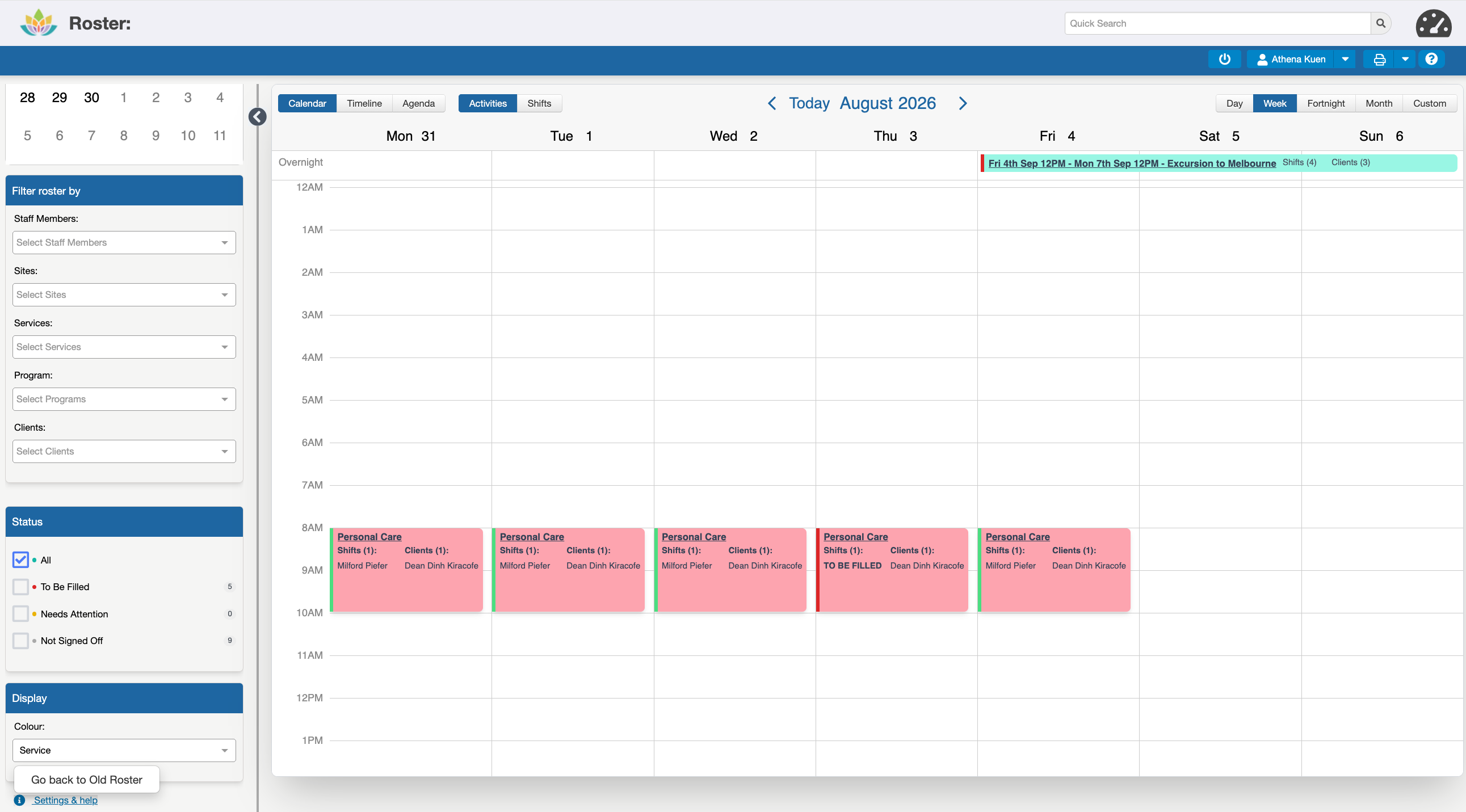
SupportAbility remembers this preference and applies it the next time you access the Roster. Select 'Go to New Roster' to return.
Version history
The Roster was first introduced in SupportAbility Web App v9.0 (May 2025), with enhancements delivered across subsequent releases. The SupportAbility Roadmap article outlines what is planned for delivery in upcoming releases.
| Release | What changed |
|---|---|
| v9.16 (Oct 2026) | Print action, with Activity Location and Staff Notes options in the Agenda view. Fortnight, Month and Custom date ranges available when displaying Shifts in the Agenda view, with a limit of 1,700 results displayed at once. Agenda view listed in start time order, grouped by Service @ Site within each start time. Activity Location displayed on Shift rows in the Agenda view. Inactive Staff Members listed in the Staff Member filter only where they have Shifts in the period displayed.
|
| v9.14 (August 2026) | Search bar above the staff rows in the Timeline view, with match counts. Status filter. Filter chips beneath each filter. Fortnight and Custom date ranges. Sidebar restructured into 'Filter roster by' and 'Display'. Colour moved into the Display section. Top bar restructured, with the Activities and Shifts toggle, centred date navigation and period pills replacing the previous drop-down menus. |
| v9.12 (June 2026) | Shifts available in the Agenda view. Activities and Shifts grouped by Service or Site in the Agenda view. Return to the Staff Member's row after a drag and drop allocation. |
| v9.10 (April 2026) | Agreed Hours displayed in the Timeline view. |
| v9.8 | Streamlined swimlane heights in the Timeline view for clearer drag and drop. Activity and Shift Sign Off status icons visible to Team Leaders. Shifts marked 'Not Paid' excluded from Agreed Hours and Potential Overtime calculations. |
| v9.7 | Timeline view cards sorted by modified date. |
| v9.5 (November 2025) | Agenda view of Activities. Roster cards coloured by Site or Service. |
| v9.4 | Staff Availability displayed in the Timeline view. |
| v9.3 | Timeline view of Shifts by day. Drag and drop allocation. Icons and amber alert stripe. |
| v9.2 (July 2025) | Activities can be created from the Roster. |
| v9.0 (May 2025) | Roster introduced. |